
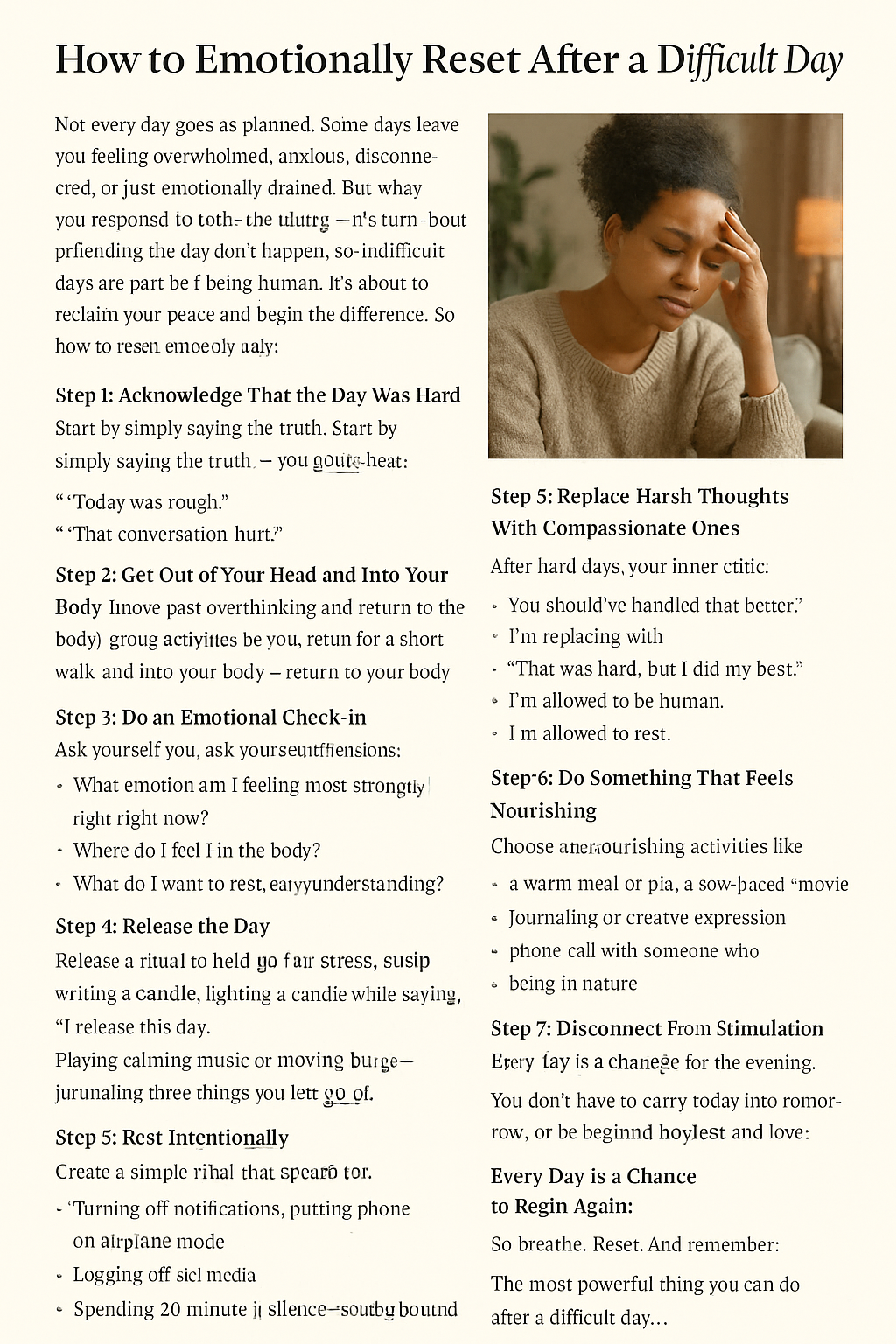
Not every day goes as planned. Some days leave you feeling overwhelmed, anxious, disconnected, or just emotionally drained. Whether it’s a tough conversation, too many responsibilities, or a wave of inner tension, difficult days are part of being human.
But the way you respond to those days — the way you care for yourself afterward — makes all the difference. An emotional reset isn’t about pretending the day didn’t happen. It’s about processing your experience, releasing what you no longer need, and gently returning to yourself.
Here’s how to reset emotionally after a hard day, so you can reclaim your peace and begin again.
Step 1: Acknowledge That the Day Was Hard
You don’t need to minimize or dismiss what happened. Start by simply saying the truth:
- “Today was rough.”
- “That conversation hurt.”
- “I feel like I was carrying too much.”
Naming your experience helps release resistance. You stop fighting the feeling and start creating space for healing.
Step 2: Get Out of Your Head and Into Your Body
After a difficult day, your mind might be swirling. Replaying events. Overthinking conversations. Questioning your worth.
The fastest way to interrupt that cycle is to return to your body:
- Take a shower and imagine the stress washing off
- Go for a short walk and focus on the rhythm of your steps
- Stretch slowly, focusing on the parts of your body holding tension
- Place your hand on your chest or stomach and breathe deeply
Let your body become a place of safety again.
Step 3: Do an Emotional Check-In
Take a quiet moment to ask yourself:
- What emotion am I feeling most strongly right now?
- Where do I feel it in my body?
- What do I need in this moment — comfort, space, understanding?
You don’t need to solve anything. Just acknowledge what’s real for you.
Try saying:
- “I feel _____, and that’s okay.”
- “This emotion is allowed. It doesn’t define me.”
- “I can feel this and still care for myself.”
Step 4: Release the Day
Carrying stress into the evening only delays your healing. Create a simple ritual to help you let the day go.
Options include:
- Writing a short reflection: What happened? How did I feel? What do I want to leave behind?
- Lighting a candle, closing your eyes, and saying, “I release this day.”
- Playing calming music and moving your body freely
- Journaling three things you’re letting go of — and then tearing up the paper
This symbolic release helps your nervous system shift from survival to recovery.
Step 5: Replace Harsh Thoughts With Compassionate Ones
After hard days, your inner critic often gets loud. It says:
- “You should’ve handled that better.”
- “Why can’t you just be stronger?”
- “You’re too sensitive.”
This is when you need compassion the most.
Try replacing those thoughts with:
- “That was hard, but I did my best.”
- “I’m proud of how I showed up, even if it wasn’t perfect.”
- “I’m allowed to be human. I’m allowed to rest.”
Let your inner voice become your safe space — not another source of pressure.
Step 6: Do Something That Feels Nourishing
Difficult days often leave you emotionally depleted. The best way to refuel isn’t with distraction — it’s with nourishment.
Choose something simple that speaks to your emotional needs:
- A warm, comforting meal or tea
- A soft blanket and a slow-paced movie
- Journaling or creative expression
- A phone call with someone who listens without judgment
- Being in nature, even for 5 minutes
You don’t have to feel better right away. You just need to feel supported.
Step 7: Disconnect From Stimulation
When your mind is overloaded, more input only makes things worse. Give yourself permission to unplug for the evening.
Try:
- Turning off notifications
- Putting your phone on airplane mode
- Logging off social media
- Spending 20 minutes in silence — no screens, no background noise
Stillness creates space for your emotions to settle and your mind to soften.
Step 8: Rest Intentionally
Instead of collapsing into bed still carrying the weight of your day, create a short wind-down ritual that signals to your body: It’s safe to rest.
Options:
- Dim the lights and stretch gently
- Write down one thing you’re grateful for — even if it’s just your breath
- Say to yourself: “I did enough. I am enough. I can rest now.”
This final moment of care helps your body shift into true restoration.
Final Thought: Every Day Is a Chance to Begin Again
You don’t have to carry today into tomorrow. You don’t have to be defined by how the day went, how you felt, or what you couldn’t control.
You are allowed to start over — not because the day was perfect, but because you are worthy of peace, even in the midst of imperfection.
So breathe. Reset. And remember:
The most powerful thing you can do after a difficult day…
is return to yourself — with gentleness, with truth, and with love.