
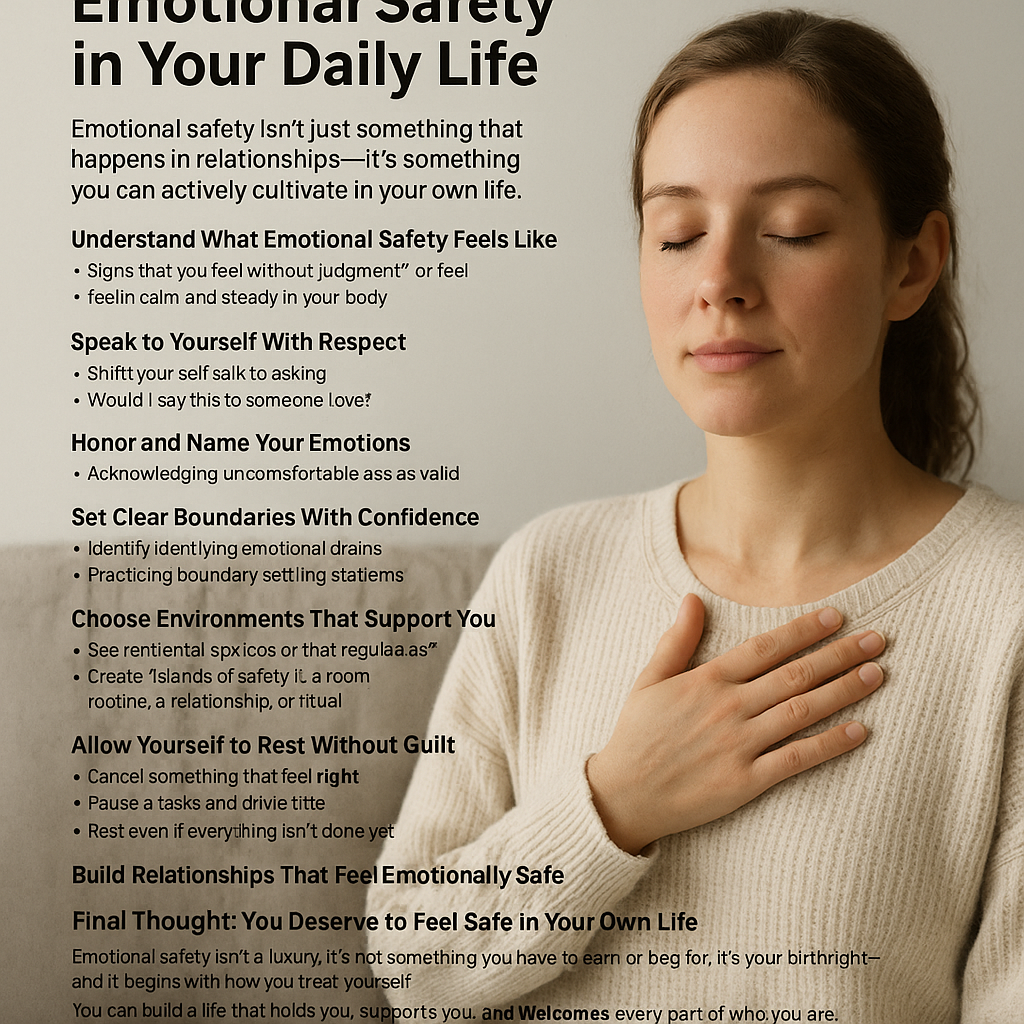
Emotional safety isn’t just something that happens in relationships — it’s something you can actively cultivate in your own life. It’s the feeling of being able to show up fully, feel deeply, speak honestly, and rest without fear of being judged or rejected.
When you feel emotionally safe, you’re more creative, more connected, and more grounded. You stop living in survival mode and start living from a place of trust and self-respect. And the best part is: you can create that safety, even in a chaotic world.
Here’s how to build emotional safety in your everyday life — from the inside out.
Understand What Emotional Safety Feels Like
Emotional safety is the experience of being accepted, seen, and allowed to be your full self. It means you can express your emotions, needs, and boundaries without fear of punishment or shame.
Signs that you’re emotionally safe:
- You can name your feelings without judgment
- You feel calm and steady in your body
- You can ask for what you need without guilt
- You trust yourself to handle emotional discomfort
- You don’t feel like you need to perform or hide who you are
This is the foundation for deeper connection — with yourself and with others.
Speak to Yourself With Respect
Creating emotional safety starts with your inner voice. If you’re constantly criticizing or pressuring yourself, your body will stay in a reactive state.
Shift your self-talk by asking:
- Would I say this to someone I love?
- What would it feel like to speak with compassion instead of control?
- Can I let this be hard without making it mean something bad about me?
When your inner world becomes a safe space, everything else becomes easier.
Honor and Name Your Emotions
Suppressing emotions creates internal tension. Emotional safety means letting yourself feel what you feel — and understanding that your emotions are valid.
Try saying:
- “This emotion is uncomfortable, but it’s not wrong.”
- “I can sit with this feeling instead of pushing it away.”
- “All emotions are welcome — not just the pleasant ones.”
The more space you give your emotions, the less control they have over you.
Set Clear Boundaries With Confidence
Boundaries are essential for emotional safety. They protect your energy, your time, and your emotional space.
Start by identifying:
- What drains me emotionally on a regular basis?
- Where do I feel resentful, overwhelmed, or unappreciated?
- What do I need more (or less) of to feel safe?
Then practice small, clear boundary-setting:
- “I’m not available for that right now.”
- “I need some time to think before I answer.”
- “This isn’t a good fit for me anymore.”
Boundaries aren’t rejection — they’re protection.
Choose Environments That Support You
Certain spaces help you feel safe and grounded — others make you feel tense, judged, or small.
Ask:
- What environments make me feel calm and free to be myself?
- Are there places or people where I shrink or silence myself?
- What can I change to feel more supported — even if it’s small?
You can’t always control every environment, but you can create islands of safety: a room, a routine, a relationship, a ritual.
Regulate Your Nervous System Regularly
Emotional safety isn’t just mental — it’s physical. When your nervous system feels under threat, even mild stress can feel overwhelming.
Support your body by:
- Taking slow, deep breaths
- Doing gentle movement or stretching
- Lying down with your hand on your heart
- Taking screen-free breaks throughout the day
These practices tell your body: You’re safe now. You can relax.
Allow Yourself to Rest Without Guilt
You don’t have to earn rest. Emotional safety means knowing that rest isn’t a luxury — it’s a requirement.
Try giving yourself permission:
- To cancel something that no longer feels right
- To pause a task and come back to it later
- To rest even if everything isn’t done yet
Let stillness be a form of self-respect.
Build Relationships That Feel Emotionally Safe
Emotional safety is nurtured in connection, too. The people you spend time with affect how you feel — not just in big ways, but in subtle, daily interactions.
Seek relationships where you can:
- Speak freely without being dismissed
- Be your full self, even on hard days
- Disagree without fear of punishment
- Receive support without conditions
Choose people who make you feel safe, not small.
Final Thought: You Deserve to Feel Safe in Your Own Life
Emotional safety isn’t a luxury. It’s not something you have to earn or beg for. It’s your birthright — and it begins with how you treat yourself.
You can build a life that holds you, supports you, and welcomes every part of who you are.
One breath, one boundary, one kind word at a time.